Fun fact: our article on trends for 2025 was the most-read post in the history of our blog. Apparently, no one likes to navigate blindly (and we all love a good spoiler about what's to come). So, by popular demand, we're doubling down.
If you work in mining, you know that 2026 isn't just another year of "doing the same thing, but a little faster." The industry is definitely moving from a period of stabilization to an era of intelligent execution.
We analyze the most dense reports in the industry (those from McKinsey, Deloitte, and EY that you can't be bothered to read on a Friday) and filter out the noise to leave you with only the signal.
Here are the real trends that will set the tone in Supply Chain and Asset Management. No unnecessary technicalities.
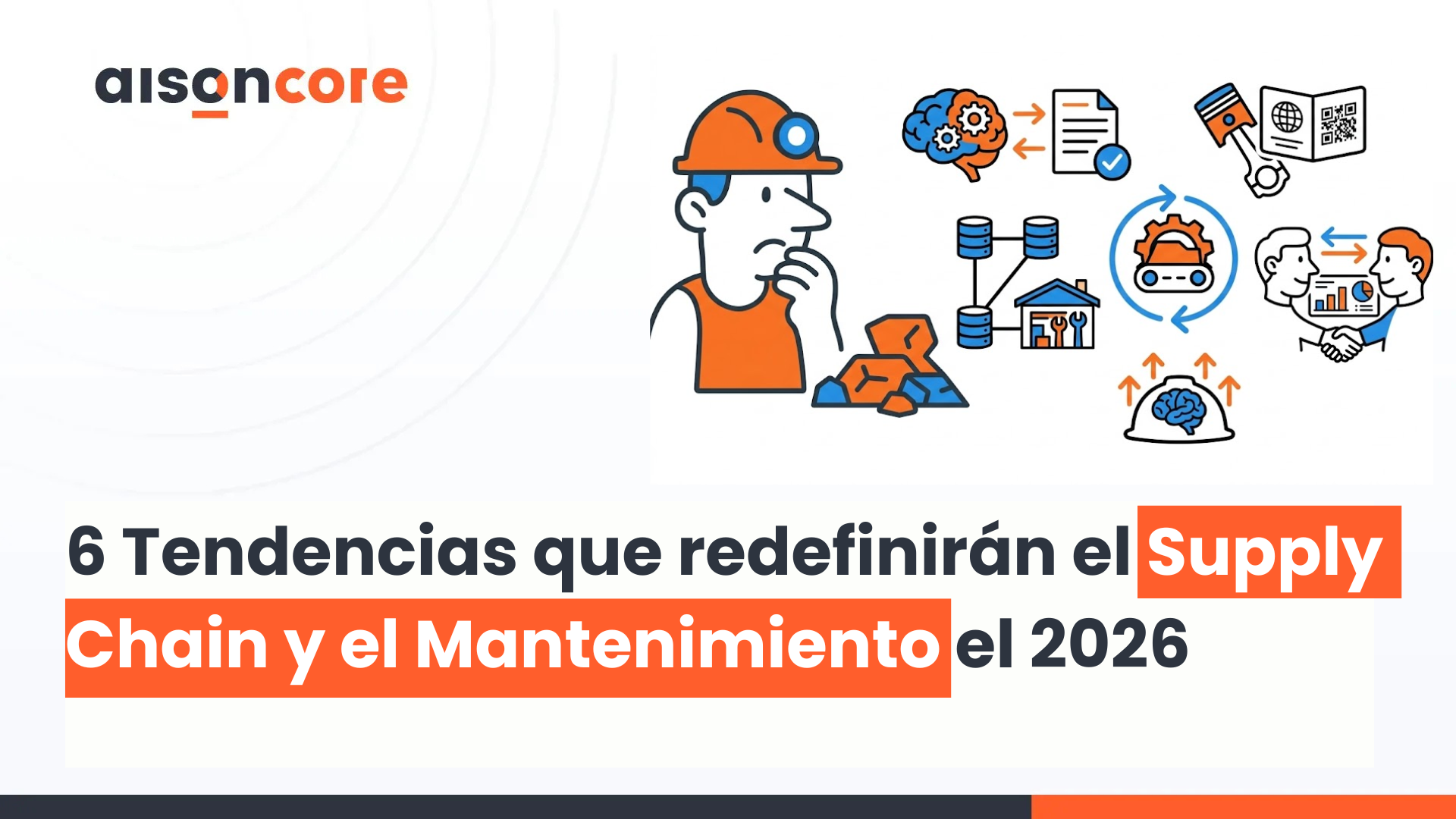
Until recently, the excitement was all about Generative AI (the kind that summarizes emails or writes manuals for you). But in Supply Chain, the real change is coming with Agent AI.
What changes? We move from systems that warn you ("Hey, this pump is going to fail") to autonomous agents that take action: they check stock, contact the approved supplier, manage the quote, and prepare the work order.
The impact: Administrative downtime is reduced. The planner is no longer a "paper pusher" and regains their role as a strategist.
For years, the corporate goal was to put all company data on a single giant server (Data Lake). The problem is that moving and cleaning that data is slow, expensive, and frustrating.
The trend: Instead of forcing everything to be centralized, 2026 is all about connecting. Data Federation allows your maintenance system to "talk" to the supplier's workshop system and logistics, without the need for monolithic integrations that take years to implement.
Aisoncore Vision: We believe that information should flow, not stagnate. You need to see the status of your component in the external workshop with the same clarity as if it were in your own yard.
Traceability is no longer optional or a "nice to have." Driven by new global regulations, the Digital Product Passport (DPP) is here.
What is it? It is a unique, immutable digital record for each critical component. It contains its origin, carbon footprint, repair history, and technical manuals.
Why it matters: No more guessing whether a remanufactured component is reliable. With a complete digital history, you have the technical certainty to reinstall it in your operation without losing sleep.
The old reliable "it broke, let's buy a new one" approach is becoming unsustainable due to cost volatility and endless delivery times.
The new standard: The Circular Economy is making its way into heavy maintenance. Leading mining companies are prioritizing the repair and remanufacturing of components over the purchase of new assets.
The data speaks for itself: Repairing can be up to 45% cheaper than buying new and drastically reduces Scope 3 emissions (those generated by your suppliers). At Aisoncore, we see this every day: extending the useful life of assets is the fastest way to be both efficient and sustainable.
The traditional "customer-supplier" relationship based on squeezing margins, sending threatening emails, and hiding information has its days numbered. In a complex environment, you need partners, not just contractors.
The change: It's about shared visibility. If your repair provider has a bottleneck, you need to know about it today, not on the day the deadline expires. Modern tools allow you to create an ecosystem where both parties see the same playing field and the rules are clear.
With the retirement of many senior experts (the famous "Silver Tsunami"), workplaces are losing tons of tribal knowledge and vital experience.
The solution: It's not about replacing your team with algorithms, but giving them Augmented Workforce tools.
In practice: A system that captures historical knowledge (which component failed, who repaired it, how, and why) allows new generations to make expert decisions from their first month on the job, supported by real data and not just intuition or a phone call to the person who just retired.
2026 will reward those who are agile and visible.
It is no longer enough to have the largest trucks or the most modern plant; the real competitive advantage will lie in how well you orchestrate information between your mine, your maintenance staff, and your external suppliers.
At Aisoncore, we built our platform precisely for this scenario: to shed light on the blind spots of your external maintenance and give you the control that this new era demands.
Does what's coming this year make sense to you? Would you like to see how Aisoncore can prepare your operation to lead these trends?
Sources and References for the most curious:
Deloitte: Tracking the trends 2025/2026
EY: Top 10 business risks and opportunities for mining and metals
McKinsey & Company: The age of analytics
Global Mining Guidelines Group (GMG)

By Bastian Andres Varas Michea
The adoption of technologies in the mining sector has evolved and taken on different perspectives in recent years. Today, it is a topic that aims not only to improve operational efficiency but also to address environmental and social concerns, making mining more responsible and sustainable.
In this article, we'll discuss how technology can play a crucial role in adapting and improving the repair process in the mining sector, covering its various aspects and implementing it.

This year, as part of our commitment to optimizing component repair processes, we set out to improve the usability of our solution, Aisoncore. And after hard work involving our entire team and greatly enriched by valuable feedback from our customers, version 2.0 was born.
What did we discover on this path of digitalization, efficiency, and usability? In this article, we share the main changes we implemented and the improvements we've achieved, which we will officially present at our next launch event .

At Aisoncore , our journey began with a bold vision: to change the game in traceability of repairable components in mining . And while the goal was clear, the path to it was often fraught with challenges and surprises we could never have anticipated. That's why, in this brief note, I wanted to share some of the paths we've traveled to reach this new launch.

Contact
© 2025 Aisoncore. All rights reserved.