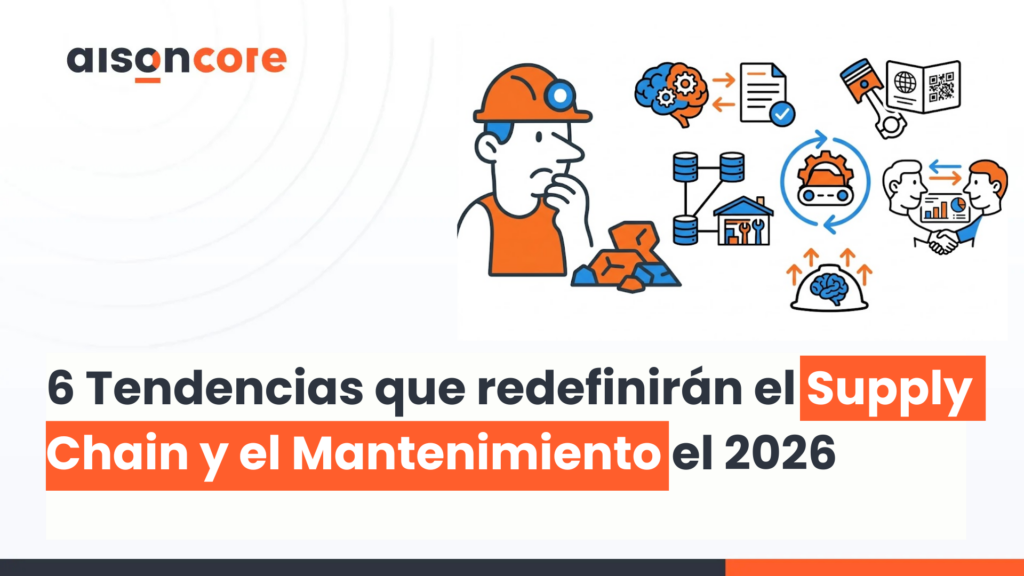
6 Trends That Will Redefine Supply Chain and Maintenance in 2026
Fun fact: our article on trends for 2025 was the most-read post in the history of our blog. Apparently, no one likes to navigate blindly (and we all love a good spoiler about what's to come). So, by popular demand, we're doubling down.
If you work in mining, you know that 2026 isn't just another year of "doing the same thing, but a little faster." The industry is definitely moving from a period of stabilization to an era of intelligent execution.
We analyze the most dense reports in the industry (those from McKinsey, Deloitte, and EY that you can't be bothered to read on a Friday) and filter out the noise to leave you with only the signal.
Here are the real trends that will set the tone in Supply Chain and Asset Management. No unnecessary technicalities.
6 Trends That Will Redefine Supply Chain and Maintenance in 2026
Fun fact: our article on trends for 2025 was the most-read post in the history of our blog. Apparently, no one likes to navigate blindly (and we all love a good spoiler about what's to come). So, by popular demand, we're doubling down.
If you work in mining, you know that 2026 isn't just another year of "doing the same thing, but a little faster." The industry is definitely moving from a period of stabilization to an era of intelligent execution.
We analyze the most dense reports in the industry (those from McKinsey, Deloitte, and EY that you can't be bothered to read on a Friday) and filter out the noise to leave you with only the signal.
Here are the real trends that will set the tone in Supply Chain and Asset Management. No unnecessary technicalities.
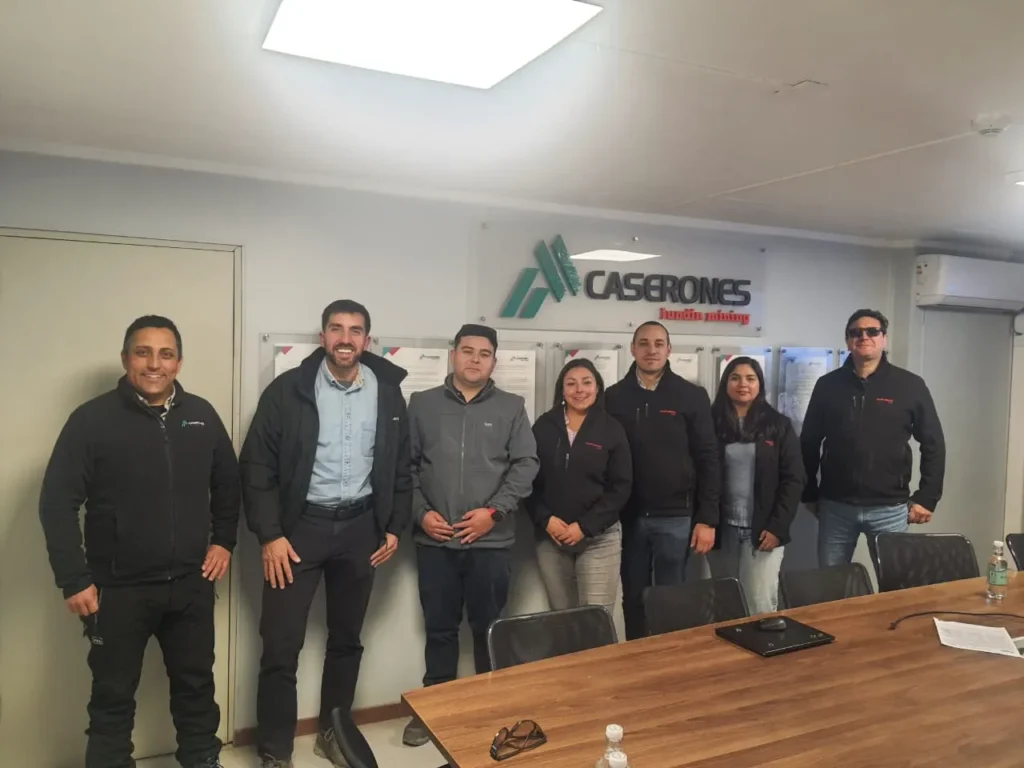
From the High Andes, Lundin Mining adds Aisoncore in Caserones
At more than 4,000 meters above sea level, where decisions weigh as much as trucks, and the margin for error shrinks along with oxygen, Caserones has decided to bet on the future. Lundin Mining has made official the launching of Aisoncore at its acquired site in 2023. The platform, which has been operating successfully at Candelaria for almost two years, thus makes a leap in scale, complexity and confidence.
But this story does not start on the mountain. It starts with a relationship built by hand, repair after repair.
Mining Supply Chain and Maintenance Outlook 2025: Interview with Patricio Valencia of Lunding Mining
One of the industries that has undergone the most transformations in recent years is mining. These changes, both strategic (mergers, discoveries, explorations) and internal (processes and technological innovation), have given rise to "mining 4.0", where all areas are connected and have a significant impact.
At Aisoncore, we have observed that Maintenance and Supply Chain have become key players in this transformation, either with strategies that drive operational efficiency and promote the circular economy. To discuss this and to know what will mark this 2025 we wanted to talk to one of our clients, Patricio Valencia who is Assistant Manager of Purchasing and Materials Engineering at Lunding Mining Chile.
Subscribe to our newsletter.
Standardizing CAEX maintenance to reduce costs in the mining industry
Maintenance of heavy-duty haul trucks (HAVs) plays a crucial role in the efficiency and profitability of the mining industry. Standardizing maintenance processes for these vehicles can help reduce costs and improve productivity. In this article, we'll explore how standardizing HAV maintenance can benefit mining companies and how digital platforms like Aisoncore can facilitate and improve this process.
Recent Posts


The role of technology in the evolution of the mining repair process
By Bastian Andres Varas Michea
The adoption of technologies in the mining sector has evolved and taken on different perspectives in recent years. Today, it is a topic that aims not only to improve operational efficiency but also to address environmental and social concerns, making mining more responsible and sustainable.
In this article, we'll discuss how technology can play a crucial role in adapting and improving the repair process in the mining sector, covering its various aspects and implementing it.

The story behind Aisoncore V2.0: Innovation and collaboration in component traceability
At Aisoncore , our journey began with a bold vision: to change the game in traceability of repairable components in mining . And while the goal was clear, the path to it was often fraught with challenges and surprises we could never have anticipated. That's why, in this brief note, I wanted to share some of the paths we've traveled to reach this new launch.

Transforming traceability of repairables into an efficient and intuitive digital product
This year, as part of our commitment to optimizing component repair processes, we set out to improve the usability of our solution, Aisoncore. And after hard work involving our entire team and greatly enriched by valuable feedback from our customers, version 2.0 was born.
What did we discover on this path of digitalization, efficiency, and usability? In this article, we share the main changes we implemented and the improvements we've achieved, which we will officially present at our next launch event .


SaaS in mining maintenance: What it is and why it's useful.
The mining industry is lagging behind in terms of digital maturity. According to BCG's Digital Acceleration Index (DAI), this sector is 30% to 40% less digitally mature than comparable industries, such as chemicals or automotive.
However, there is a clear desire for change on the part of companies. Another Digital Maturity study conducted by Accenture in collaboration with the UC Innovation Center reveals that 60% of mining companies already have concrete digitalization plans.